
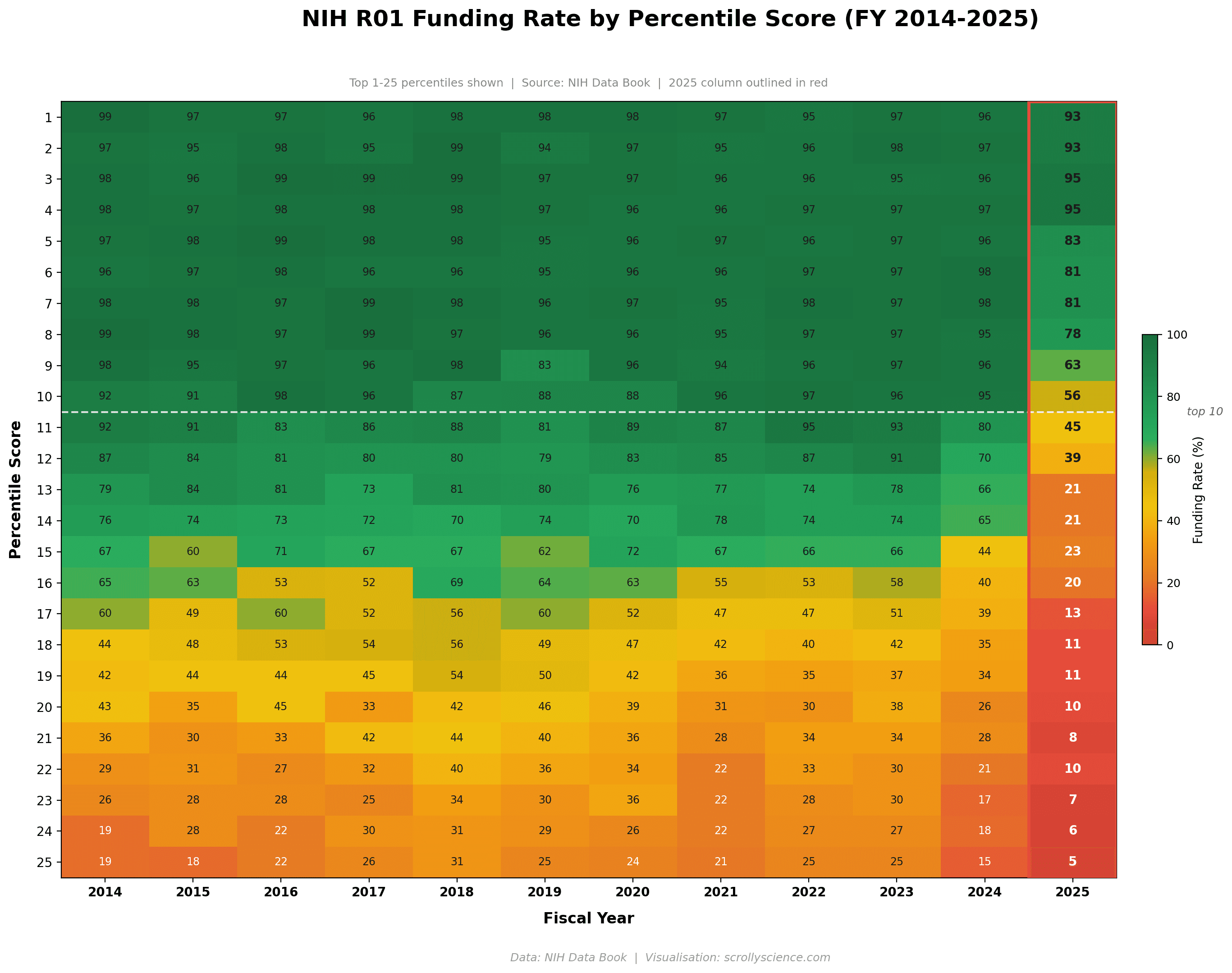
If you scored in the top 10th percentile on an NIH R01 application any time between 2014 and 2024, you could start hiring. You could plan your next three years. The cumulative funding rate for that tier sat between 94% and 97%, year after year. It was as close to a sure thing as academic science gets.
In 2025, it dropped to 81.5%. Nearly one in five of the best-scoring grants in the country went unfunded.
Let that land for a second. These aren't borderline applications. These are the grants that outscored 90% of everything submitted. And a fifth of them got nothing.
The Numbers Tell a Brutal Story
A heatmap of NIH R01 funding rates by percentile score, shared recently by Bao Nguyen on LinkedIn, laid this out in a way that hit the research community hard. The visualisation tracked funding rates across the top 25 percentiles from 2014 to 2025, and the 2025 column stands out like a warning light. What used to be a wall of green, nearly everything funded, has shifted sharply towards amber and red.
Even the top 5th percentile, the absolute elite of the applicant pool, saw funding rates fall from a consistent 97% or higher to 91.5%. Between 2014 and 2024, only 24 to 66 grants in that tier were rejected in any given year. In 2025, 155 were.
The point at which your odds drop below a coin flip tells the story most clearly. Historically, that line sat around the 17th to 20th percentile. In 2024 it moved to the 15th. In 2025, it moved to the 11th. A researcher who writes a grant that outscores 89% of all applicants now has barely better than 50/50 odds.
The Research Community Knows It
The LinkedIn comments under Nguyen's post read like a support group for people watching the rules change in real time. Brian Gladue, an Executive Vice President for Research and Innovation, pointed to score compression as a root cause: reviewers, in an effort to help strong proposals, are handing out too many high scores. When most competitive grants cluster between the 5th and 10th percentile, the whole system becomes a knife-edge fight for the top one percent. The scoring mechanism designed to identify the best science is instead creating a bottleneck where excellent and outstanding become statistically indistinguishable.
Chloe Bird, a senior health researcher and FAAAS fellow, raised an even more uncomfortable question: is the best science actually getting funded? Budget uncertainty across NIH institutes, combined with new restrictions on no-cost extensions, means that even grants likely to be funded late in the fiscal year are sitting in limbo. The delays, the gaps, the lost momentum, none of that shows up in a percentile score, but it shapes what researchers can actually do.
Ruth Fisher, an economist, framed it structurally: as competition increases, incentives change, and the nature of the game shifts. Researchers aren't just competing on science any more. They're competing on everything around the science.
Marxa Figueiredo, an associate professor at Purdue, put it simply: even the top 15th percentile used to be in the green zone. That world is gone.
What This Means for How You Communicate Your Research
Here's where this connects to something we think about constantly at Scrolly Science.
When funding rates were high and strong scores meant guaranteed money, there was less pressure on everything surrounding the grant. Your figures didn't need to be exceptional. Your preliminary data section didn't need to tell a cinematic story. Your broader impacts statement could be a box-ticking exercise. The science carried the day.
That margin has evaporated. When a researcher scoring in the 11th percentile has coin-flip odds, every element of the application becomes a differentiator. The clarity of your visual figures. The persuasiveness of your narrative. The way you frame significance for a reviewer who's read forty proposals that week and needs a reason to champion yours in a study section. The strength of your broader impacts plan, and whether it looks like something you've actually thought about or something you copied from your last submission.
And it goes beyond the grant itself. Funders increasingly look at whether a PI can demonstrate public engagement, media reach, or evidence that their previous work had impact beyond the journal. An NIH programme officer deciding between two grants at the same percentile isn't just reading the science. They're looking at the whole picture. Does this researcher communicate well? Do they have a track record of making their work visible? Will funding them generate outcomes that justify the investment?
This is where science communication stops being a nice-to-have and starts being a strategic tool. A 90-second explainer film of your research, a professionally designed project website, a visual summary that a programme officer can share with a congressional staffer, these aren't luxuries. In a funding environment where the difference between funded and unfunded is thinner than it's ever been, they're leverage.
The Irony of the Viral Heatmap
There's something worth noting about Nguyen's original post. It went viral. Not because the data was new, the NIH Data Book has been public for years. It went viral because of how it was communicated. A single, well-designed heatmap told a story that thousands of words of budget analysis couldn't. Researchers, administrators, programme managers, and policy people all shared it because they could see the problem instantly. The data was the same. The communication made it land.
That's not a coincidence. That's the point. Complex data, communicated visually, with clarity and intent, reaches people that raw numbers never will. And right now, in a funding environment where the margin between success and failure is vanishing, being able to communicate your work that way isn't optional. It's the edge that might keep your lab running.
Scrolly Science works with researchers and institutions to turn complex science into visual content that reaches the people who need to see it. We've worked with over 14,000 academics and generated over half a billion social media impressions across video, animation, and digital content. If your research deserves to be seen, we'd love to help. scrollyscience.com